Skip to content
Atlanta is filled with charming older homes, from historic bungalows in Grant Park and Virginia-Highland to mid-century ranches throughout Decatur and East Cobb. While these homes often offer character you cannot find in newer construction, many share one common challenge: they were never designed for modern central air conditioning.
For homeowners dealing with hot upstairs bedrooms, aging window units, or costly ductwork retrofits, ductless mini-splits often emerge as an attractive alternative. But are they actually the right solution for an older Atlanta home? The answer depends on how your home is built, where comfort problems exist, and what long-term goals you have for efficiency and comfort.
Why Do Older Atlanta Homes Struggle With Cooling?

Many older Atlanta homes were built decades before central air became standard. Some were originally heated with boilers and radiators, while others relied on floor furnaces, attic fans, or simple natural ventilation. As a result, cooling systems were often added later rather than designed into the home from the beginning.
That creates challenges that become especially noticeable during Atlanta’s long, humid summers. Temperatures regularly climb into the upper 80s and 90s while humidity levels push indoor comfort even lower. Homes with limited ductwork or no ductwork at all often develop hot spots that traditional cooling systems struggle to reach.
Common Cooling Challenges in Older Atlanta Homes
| Home Characteristic | Cooling Challenge |
|---|---|
| No existing ductwork | Central AC installation becomes expensive |
| Finished attic spaces | Heat accumulates quickly during summer |
| Historic plaster walls | Duct installation can be highly disruptive |
| Home additions | Existing HVAC may not reach new spaces |
| Large shade trees | Uneven temperatures throughout the home |
| Original insulation | Higher cooling demand and longer runtimes |
Many homeowners initially try solving these issues with window units or portable AC systems, but those solutions often create uneven comfort, higher energy bills, and added noise.
How Does a Ductless Mini-Split Work?
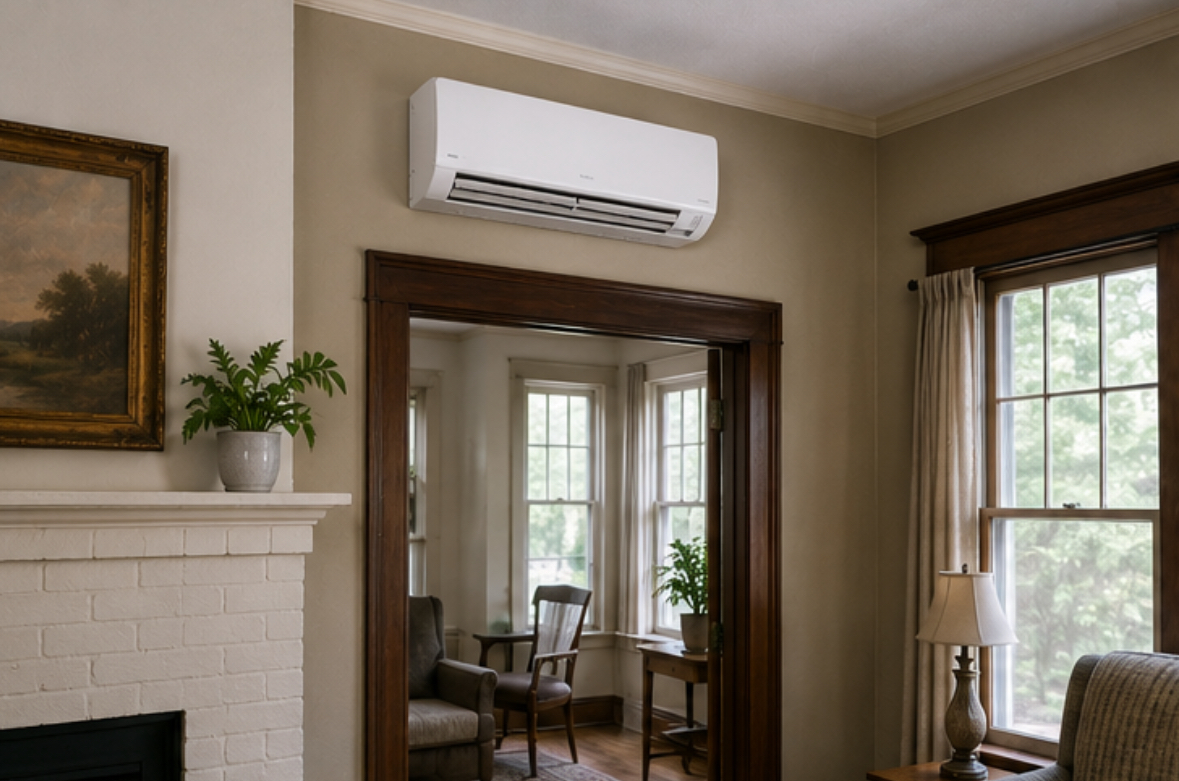
A ductless mini-split system uses an outdoor heat pump connected to one or more indoor air-handling units through a small bundle of refrigerant lines and electrical wiring. Instead of cooling air in a central location and pushing it through ductwork, each indoor unit delivers conditioned air directly into the space it serves.
Because no ducts are required, installation is far less invasive than adding a traditional central air system. In most cases, technicians only need a small wall penetration to connect the indoor and outdoor components.
What Makes Mini-Splits Different?
Traditional HVAC systems often lose 20% to 30% of conditioned air through duct leakage, especially in older homes where ducts run through hot attics or crawlspaces. Ductless systems eliminate those losses entirely because the cooling is delivered directly where it is needed.
The system also uses inverter-driven technology that continuously adjusts output rather than repeatedly cycling on and off. That allows the equipment to maintain more stable indoor temperatures while improving efficiency during Atlanta’s long cooling season.
Why Are Mini-Splits Often Ideal for Homes Without Ductwork?

The biggest advantage for many Atlanta homeowners is simple: mini-splits provide whole-room comfort without requiring major renovation work. Installing central air in a home with no existing ducts often means opening walls, modifying ceilings, sacrificing closet space, and navigating structural limitations that can significantly increase project costs.
Mini-splits avoid most of those challenges. The indoor units can be installed exactly where cooling is needed, while the outdoor unit remains discreetly located outside the home.
Situations Where Mini-Splits Often Make Sense
- Historic homes where preserving original architecture is important
- Older homes heated by boilers or radiators
- Finished attics converted into bedrooms or offices
- Garage apartments and detached living spaces
- Home additions never connected to the original HVAC system
- Homes where duct installation would require major remodeling
For many homeowners, avoiding the disruption and cost of extensive ductwork becomes one of the strongest reasons to consider a ductless solution.
What Comfort and Energy Benefits Do Mini-Splits Offer?
Beyond solving the ductwork problem, mini-splits often improve comfort in ways that older homes have struggled with for years. Instead of treating the entire house as a single zone, mini-splits allow homeowners to target specific rooms and adjust temperatures independently.
That flexibility can be especially valuable in Atlanta homes where second floors, sunrooms, and additions frequently experience very different cooling needs than the rest of the house.
Benefits Older Atlanta Homeowners Often Notice
| Benefit | Why It Matters |
|---|---|
| Room-by-room temperature control | Eliminates hot and cold spots |
| Lower energy consumption | Only cool occupied spaces |
| Improved humidity control | Important during Atlanta summers |
| Quiet operation | Much quieter than window units |
| No duct losses | Greater overall system efficiency |
| Year-round heating capability | Heat pump operation for winter use |
Many homeowners also appreciate that modern mini-splits include advanced filtration systems that help reduce airborne dust, pollen, and allergens, an added benefit during Atlanta’s lengthy allergy seasons.
Can a Mini-Split Handle Atlanta’s Heating Needs Too?
Many homeowners initially look at mini-splits as a cooling solution, but modern systems are actually heat pumps, meaning they provide both heating and cooling from the same equipment. That dual-purpose capability can be especially appealing in Atlanta, where winters are generally mild compared to northern climates.
While temperatures occasionally dip below freezing, most winter days remain well within the operating range where modern ductless heat pumps perform efficiently. Instead of generating heat through combustion like a furnace, the system transfers heat from outdoor air into the home, which often results in lower operating costs and more consistent comfort.
How Mini-Splits Fit Atlanta’s Climate
For many older Atlanta homes, a ductless system can serve as:
- A primary comfort system for additions or renovated spaces
- Supplemental heating and cooling for rooms with comfort issues
- A replacement for aging window units and space heaters
- A whole-home solution in smaller houses without ductwork
- A way to reduce reliance on older, less efficient heating equipment
Homeowners considering a full comfort upgrade often compare a mini-split system alongside a traditional heat pump installation or air conditioning replacement to determine which option best fits their home’s layout and long-term energy goals.
What Should Homeowners Consider Before Installing a Mini-Split?

Mini-splits solve many problems, but they are not automatically the right answer for every house. The best results come from matching the system design to the home’s layout, insulation levels, and comfort challenges rather than simply adding equipment to a problem area.
Older Atlanta homes vary dramatically in construction. A 1920s bungalow in Inman Park, a 1950s ranch in Decatur, and a renovated craftsman in Virginia-Highland all present different cooling loads and installation considerations. Proper sizing becomes especially important because an oversized unit can short-cycle and struggle with humidity control, while an undersized system may never fully satisfy the space.
Factors That Affect System Design
| Consideration | Why It Matters |
|---|---|
| Room size and ceiling height | Determines capacity requirements |
| Insulation levels | Impacts heating and cooling loads |
| Sun exposure | South- and west-facing rooms gain more heat |
| Window efficiency | Older windows increase cooling demand |
| Number of zones needed | Influences equipment selection |
| Future renovation plans | May affect long-term system design |
This is why a professional load calculation matters. The most successful mini-split installations are designed around how the home actually performs rather than relying on generic square-footage estimates.
Why Choose Indoor Experts for Ductless Mini-Split Installation in Atlanta?
Older Atlanta homes present unique comfort challenges that standard HVAC solutions do not always solve efficiently. Whether you’re dealing with a home that never had ductwork, an overheated finished attic, a room addition that never feels comfortable, or rising energy bills from window units, the right ductless system can provide targeted comfort without major renovation.
At Indoor Experts, we evaluate more than just the room size. Our licensed team looks at insulation levels, sun exposure, airflow patterns, humidity concerns, and how your home is actually used before recommending a solution. That approach helps ensure your ductless mini-split installation delivers the comfort, efficiency, and reliability you expect for years to come.
Schedule an evaluation today and discover whether a ductless mini-split is the right fit for your Atlanta home.