
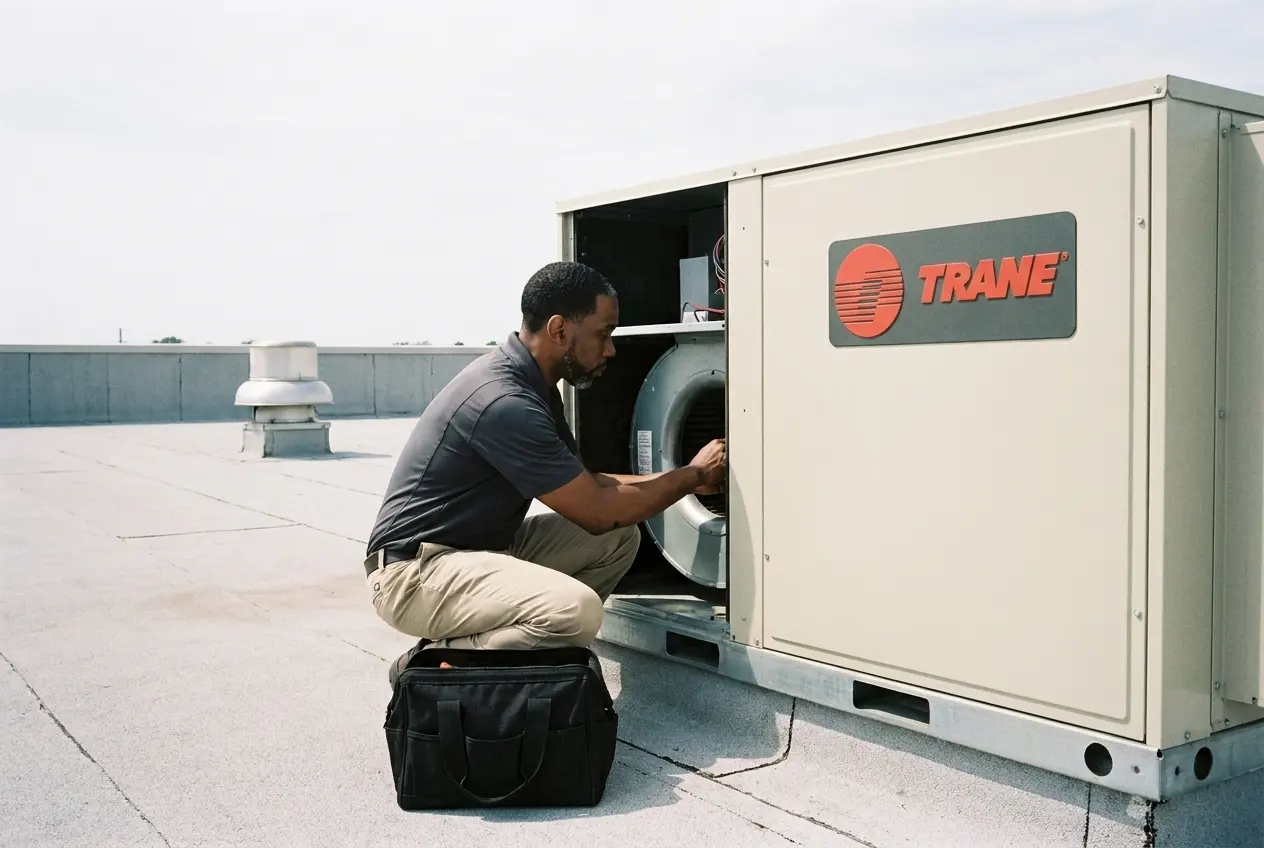
Rooftop units for Atlanta buildings.
Indoor Experts Heating & Air Conditioning services rooftop units across Atlanta and Decatur. A packaged unit puts the whole system in one cabinet on the roof, so a fault up there takes the heating and the cooling with it. Tell us what the unit is doing and we will tell you what we find.
- Packaged AC, gas-electric and heat pump units
- Licensed GA CN211042
- Written price before any work starts
Book a visit
Tell us what the unit is doing and pick a time that suits the building.
We answer Mon-Fri 8am-6pm. The price for any work is in writing before anything starts.
One cabinet on the roof doing both jobs
A split system puts the condenser outside and the air handler inside. A packaged unit, sometimes called a rooftop unit or an RTU, puts the compressor, the coils and the blower in a single cabinet, and that cabinet usually sits on the roof. It is the normal arrangement on small commercial buildings in Atlanta because it keeps the equipment out of the floor space and the service access off the shop floor.
It also means one failure can take out heating and cooling together, and that everything about the repair happens on a roof. That changes access, it changes how the unit is got up there when it needs replacing, and it changes what a service visit involves. This is commercial work and it sits under our commercial HVAC page, which covers who is responsible for what and how a commercial call runs.
The packaged units we service and replace
Which one is on your roof decides what can fail and what a replacement costs. If you do not know which you have, the data plate on the cabinet will say, and we will read it for you on the first visit.
Packaged air conditioners
Cooling in the cabinet, with the heat coming from somewhere else in the building or from nothing at all. The simplest of the three, and the one where a summer fault is unambiguous.
Packaged gas-electric units
Electric cooling and a gas burner section in one cabinet. Two heat sources in one box means two sets of things to check, and a fault in the gas section can leave the cooling working perfectly.
Packaged heat pumps
One refrigerant circuit that runs both ways, with electric heat strips behind it for the coldest days. Most of the faults that only show up in winter are in the changeover or in those strips.
What a packaged unit does before it stops
A rooftop unit is out of sight and out of earshot, so it rarely gets looked at until something in the building changes. These four are what people notice from downstairs.
Unusual noises
Grinding, rattling or a new hum that carries down through the ceiling. Something is either loose in the cabinet or a bearing is going, and neither improves on its own.
Spiking energy bills
The unit is running longer to do the same work. A bill that climbs while the weather and the occupancy stay flat is the unit telling you it has lost efficiency.
Weak or inconsistent airflow
One area of the building never gets there while another is fine. That points at the blower, at the filters, or at the duct run between the roof and the space.
Short-cycling
The unit starts, runs briefly and stops, over and over. It never reaches the temperature and every start puts wear on the compressor, which is the most expensive part in the cabinet.
What we work out before quoting a new one
A rooftop replacement is not a like-for-like swap decided from the old model number. Four things get measured first, and each one can change the unit that goes up there.
Building size and layout
How much space the unit actually has to condition, and how that space is divided. Oversizing a packaged unit makes short-cycling worse, not better.
Roof structure and accessibility
What the roof will carry, where the existing curb sits, and how equipment gets up and down. This is often the part that decides the cost of the job rather than the unit itself.
Fuel source availability
Whether there is gas at the roof at all. No gas means a heat pump or electric heat, and that is a decision made before anything is priced.
Budget and efficiency ratings
A higher-rated unit costs more up front and less to run. We will show you both numbers rather than pick for you, and the price is in writing before anything is ordered.
What goes wrong, and when, in Georgia
Rooftop faults are seasonal because the load on the unit is seasonal. Knowing which season you are in narrows down what we are looking for before anyone goes up the ladder.
Humidity and drain line failures
The unit starts pulling real moisture out of the air again for the first time since autumn, and anything blocked in the condensate path shows up as water where it should not be.
High-load component breakdowns
Peak Georgia heat runs the unit near its limit for weeks. Capacitors, contactors and fan motors are the parts that give out under that load.
Mode-change and control issues
The first call for heat is when a control fault that has been sitting there all summer finally shows itself. Cooling worked yesterday, heating does nothing today.
Defrost and heat strip failures
On a packaged heat pump, a defrost board or a failed heat strip means the unit runs but the building never warms up. Both are winter-only faults.
Our hours, said plainly
We answer Mon-Fri 8am-6pm. If a unit fails outside those hours, leave us a booking and we will pick it up when we open rather than promise you somebody at two in the morning. For a building that cannot carry that risk, a scheduled service plan is the honest answer, and the commercial page covers how those work.
Rooftop unit questions we get asked most
Question we didn't cover? Ask before you book, that's what the phone is for.
01Do you service rooftop units in Atlanta?
02What is the difference between a rooftop unit and a split system?
03Which packaged units do you work on?
04Is the price agreed before any work starts?
05When can you get to the building?
Read the reviews before you call anyone
These are Atlanta homeowners talking about work we did, not paid testimonials.
-
5 out of 5 stars
AC repairWe’ve had unfortunate luck as our downstairs AC unit has had issues on multiple occasions where it stopped working and it’s only 4 years old. However, [the owner] and his staff have always promptly evaluated every issue and fixed so quickly. They are very professional and thorough while still getting the job done quickly. This company is fair with their pricing and trustworthy…
Lydia KanoyGoogle reviewRead it on Google -
5 out of 5 stars
AC repairI had a really great experience with Indoor Experts. My A/C unit was not cooling the house very well. I called Indoor Experts because of their great online reviews. I met with [the owner] who quickly diagnosed the issue and proposed the solution. The repair cost was very reasonable. My A/C is working great now, and I would use this company again in a heart beat…
Zachary KozuchGoogle reviewRead it on Google -
5 out of 5 stars
AC repairGreat customer service. Our unit is fairly new, so I was surprised when it died last night. I was able to call and get an appointment this evening, which was wonderful. [the owner] took one quick look at the unit, knew exactly how to fix it, and did so right away. The pricing was also very reasonable, and he didn't try to up sell anything (I can't stand pushy sales people)…
Tabitha CareyGoogle reviewRead it on Google -
5 out of 5 stars
AC repairI would absolutely recommend Indoor Experts and [the owner] to any and everyone. I called them after the first HVAC company did not fix my problem. [the owner] and Savon were here until 11:30pm working on my unit to be sure that we had AC over night…
Jessica BradyGoogle reviewRead it on Google -
5 out of 5 stars
AC repairThe Indoor Experts team is top-notch. Everyone involved from the call agent to the technician was extremely professional and helped me get my AC fixed as soon as they could. A special thank you and appreciation to their technician, [the owner]. He diagnosed the problem quickly and fixed my AC issue within a couple of hours. He was clear in communicating the issue and how he was going to fix it…
Tyler WoeiGoogle reviewRead it on Google -
5 out of 5 stars
AC repairHonest, fair, efficient & effective. Identified and fixed my problem with an old AC unit in less than an hour and at a much lower cost than I anticipated. Highly recommended! My experience was 100% positive.
Chase AndersonGoogle reviewRead it on Google
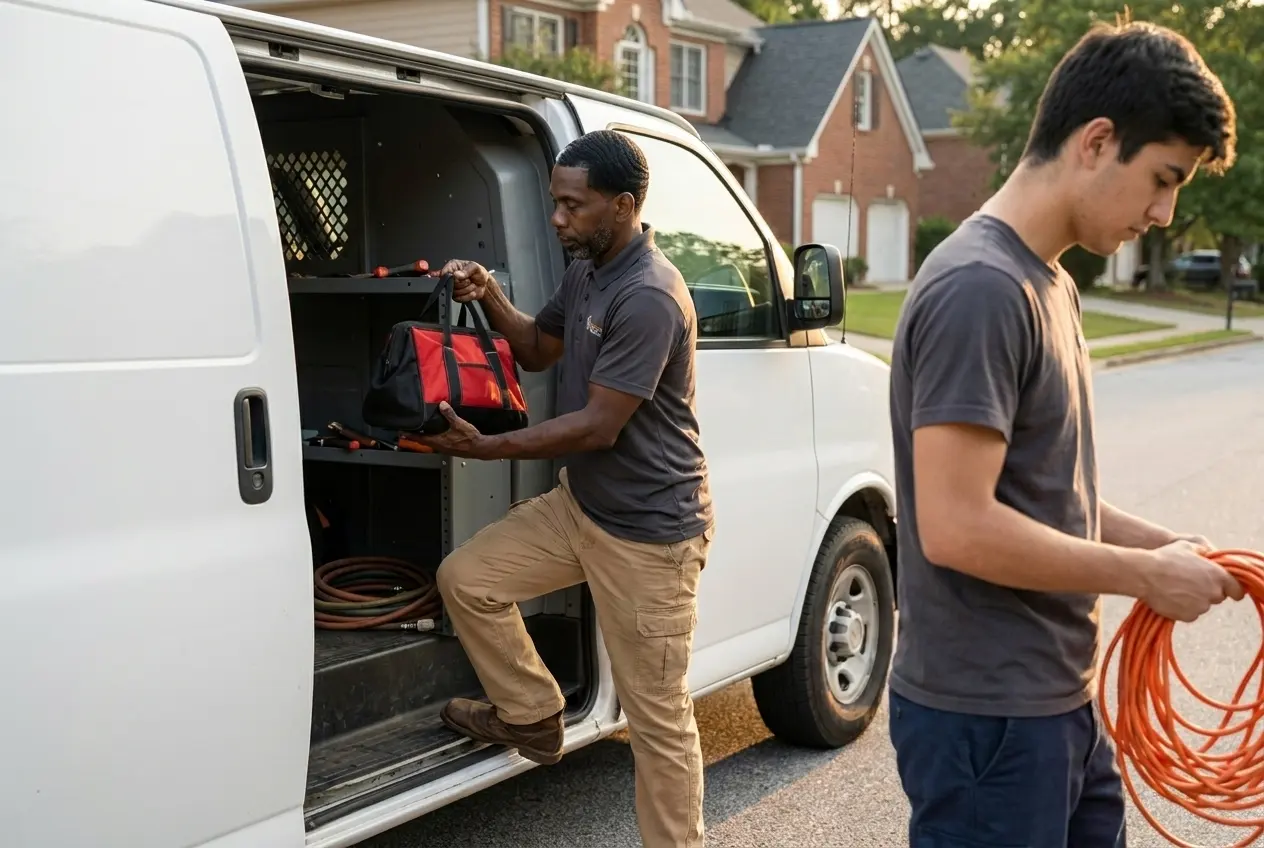
Tell us what the unit is doing.
What changed in the building, when it started, and which unit it is if you know. You get the diagnostic price up front and the repair price in writing before anything starts.