
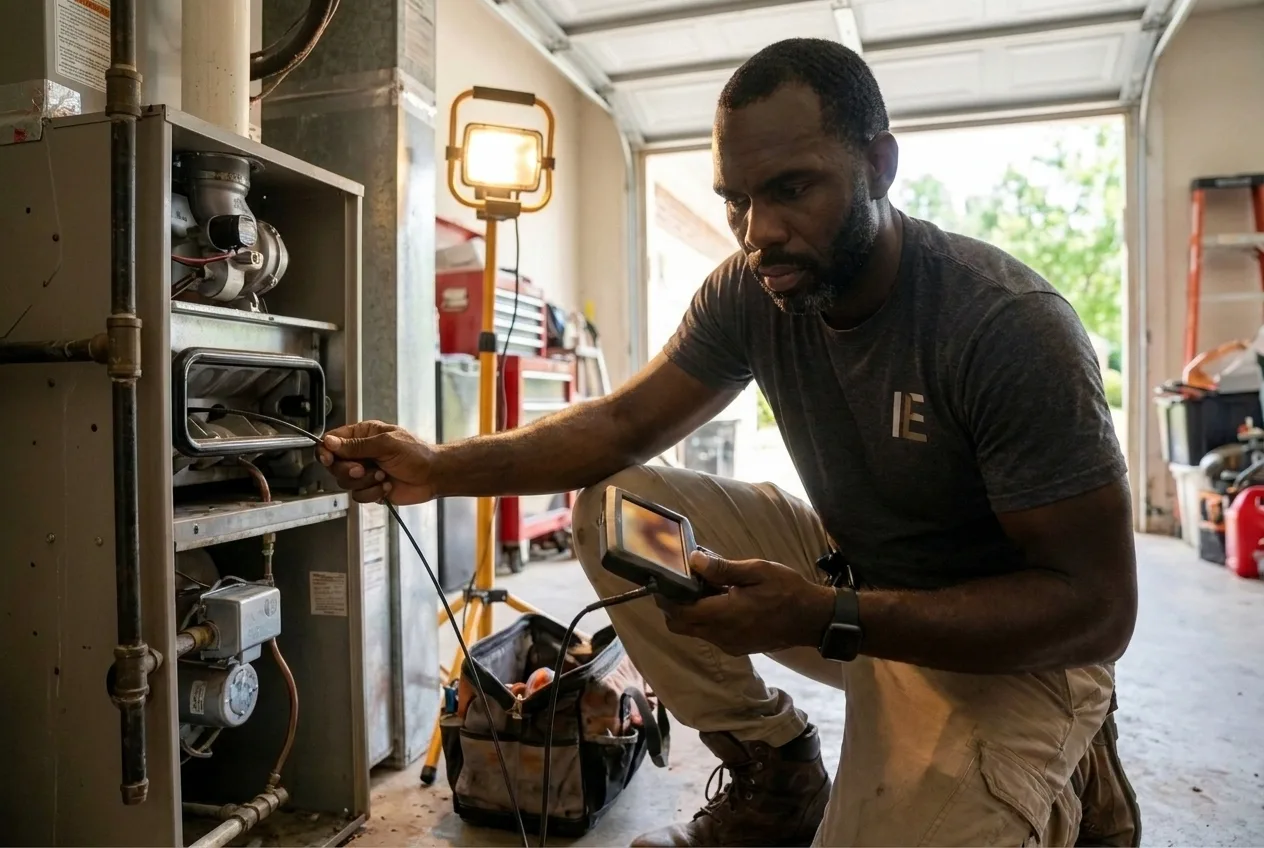
The questions Atlanta homeowners actually ask us
Written by Msemaji Anderson, Owner, Indoor Experts Heating & Air Conditioning. Published September 2026. Updated September 2026.
When you should get emergency HVAC services
01My carbon monoxide alarm went off, but the furnace seems to be heating normally. Is it a false alarm, and can I turn the furnace back on once it stops?
Treat the alarm as a safety warning even if the furnace still produces warm air. Get everyone outside, leave the heating system off, and do not restart it until the source of the carbon monoxide has been checked.
A furnace can keep heating while a combustion or venting problem allows carbon monoxide into the home. The source may also be another gas appliance or an attached garage, so the furnace should not be assumed to be the cause. The alarm stopping does not prove the problem has cleared. Stay outside and have the source tested before using the furnace again.
02We had an ice storm and my heat pump is caked in ice. Can I pour warm water on it, or should I switch to emergency heat until someone comes?
Do not pour water over the outdoor unit or chip the ice away. If the heat pump is covered in solid ice and cannot clear itself, switch to Emergency Heat if your system has it and leave the outdoor unit alone.
A light coating of frost can be normal during cold Atlanta weather because heat pumps periodically enter a defrost cycle. A thick layer of ice is different and may point to freezing rain, restricted airflow, or a defrost-system problem. Trying to break the ice away can damage the coil or fan. Use Emergency Heat and leave the outdoor unit untouched until it can be inspected.
03My outdoor AC unit is humming or buzzing but the fan will not spin. Is it safe to leave it running until you get here?
No. Turn the air conditioner off rather than letting the outdoor unit continue humming with a stalled fan. A failed capacitor, fan motor, contactor, or compressor-starting problem may be preventing the system from starting correctly.
When the outdoor fan is not moving, the system cannot release heat the way it should. Electrical components can continue trying to start, which may add stress to the fan motor or compressor. Do not try to spin the blade with a stick or reach inside the cabinet. Turn the system off at the thermostat and leave it off until it is checked.
04My furnace has a light flashing a code and it shut itself off. Can I reset it, and how many times before I should stop?
One reset may be reasonable if there is no burning smell, carbon monoxide alarm, or other safety warning. If the furnace shuts down again, leave it off instead of repeatedly resetting it and forcing another failed startup.
The flashing light is usually a diagnostic code that helps identify why the furnace entered a safety lockout. Depending on the system, it may point to ignition failure, overheating, airflow restriction, or a pressure-switch problem. Repeated resets can remove useful diagnostic information and keep repeating the same fault. Write down the flash pattern, then leave the furnace off if the problem returns.
Air conditioning
01Why does my air conditioner keep freezing up even after I changed the filter?
A clean filter rules out one common cause, but the system can still freeze because of weak airflow, a dirty evaporator coil, a blower problem, low refrigerant, or a refrigerant leak. Turn the cooling off and let the ice thaw before it is tested.
Ice forms when the evaporator coil gets too cold for the amount of warm air moving across it. In Atlanta's long cooling season, the problem may not show up until the system has been running hard for several hours. Continuing to run a frozen AC can send liquid refrigerant back toward the compressor and turn a smaller problem into a more expensive repair.
02My system uses R-410A. With newer refrigerants replacing it, should I replace my AC before parts become hard to find?
No. An air conditioner does not need to be replaced simply because it uses R-410A. Existing R-410A systems can continue to be serviced, and replacement components can still be supplied for repairs.
The refrigerant transition affects new equipment differently from systems already installed in homes. R-410A cannot simply be swapped for R-454B because the equipment is designed around a specific refrigerant. Age, repair history, efficiency, refrigerant leaks, and the cost of the next major repair matter more than the refrigerant label alone when deciding whether to replace the system.
03What is the white pipe dripping water outside my house, and why does my AC drain keep clogging?
It may be a secondary condensate drain. If water suddenly starts coming from a pipe that normally stays dry, the primary drain may be clogged and the backup drain is giving you an early warning.
Air conditioners remove a large amount of moisture during Atlanta's humid cooling season. That water travels through the condensate drain, where algae, dust, and buildup can eventually restrict the line. If the backup drain starts running or a float switch shuts the system down, clearing the blockage matters before water reaches an attic pan, ceiling, or surrounding equipment.
04My technician wants to add refrigerant instead of finding the leak. Is topping it off a reasonable repair?
Sometimes it can be a temporary decision, but refrigerant does not normally get used up. If the system is low, there is usually a leak somewhere. Adding refrigerant without discussing the leak leaves the underlying problem in place.
The better question is how quickly the refrigerant is escaping and whether finding and repairing the leak makes financial sense for that system. A very small leak in older equipment creates a different decision from a newer system losing its charge quickly. Ask what evidence showed the system was low and what leak-search options are available before approving repeated refills.
05My AC keeps burning through capacitors. What should be checked before I pay for another one?
Repeated capacitor failures deserve more than another capacitor. The technician should check the fan motor, compressor starting amperage, operating voltage, connections, capacitor rating, condenser condition, and whether excessive heat is contributing to the failures.
A capacitor can fail on its own, especially after years of heat exposure. When a replacement fails again soon, something else may be stressing the electrical system. Atlanta outdoor units spend months operating in high temperatures, which makes heat-related electrical problems worth investigating. Replacing the same part repeatedly without checking the load around it can leave the original cause untouched.
06A technician says my compressor has failed. What should confirm that before I approve a major repair or replacement?
A compressor diagnosis should be supported by electrical and operating measurements, not only by the fact that the outdoor unit will not start. Ask what was tested and what readings showed the compressor itself has failed.
A failed capacitor, contactor, wiring problem, overload, low voltage, or another electrical fault can sometimes resemble a compressor failure. A technician may check winding resistance, current draw, grounding, starting components, refrigerant pressures, and whether the compressor is mechanically locked. Because compressor work can change the repair-versus-replacement decision, the diagnosis should be clear before you approve it.
07Should nitrogen be flowing through the refrigerant lines when they are brazed during a new AC installation?
Yes. Flowing a small amount of nitrogen through the copper while brazing helps prevent oxidation from forming inside the refrigerant lines. That internal buildup can contaminate the system even though the outside of the joint looks clean.
This is one of the installation details homeowners rarely see once the equipment is running. Oxide flakes created inside overheated copper can travel through the refrigerant circuit and affect valves, metering devices, or compressors. It is worth asking how the installer protects the inside of the tubing during brazing, especially when new equipment is being connected to a longer line set.
08My air handler is in the attic. Should a replacement include a drain pan and an overflow shutoff switch?
An attic installation needs protection against condensate overflow because a blocked drain can damage the ceiling below before anyone notices it. The exact drain-pan and shutoff arrangement should match the equipment location and applicable installation requirements.
The primary drain handles normal condensation. A secondary pan, backup drain, or water-detection switch provides another layer of protection if that line blocks or the coil pan overflows. This matters particularly during an Atlanta summer when the system can remove moisture for hours each day. Ask the installer to show you where condensate goes and what stops the system if drainage fails.
For AC troubleshooting, diagnosis, and repair information, visit our Atlanta air conditioning repair page. Planning a new system? See our AC installation and replacement services.
Heating and furnaces
01A company told me I have a cracked heat exchanger and need a new furnace. How do I confirm that before I spend the money?
If a company tells you your heat exchanger is cracked and the furnace needs to be replaced, ask to see the evidence before approving the work. The technician should be able to show you the crack, corrosion, combustion readings, or other test results that support the diagnosis.
Heat exchangers can fail, but replacing a furnace is a major expense. Verification may include a visual inspection, combustion testing, pressure testing, or a camera inspection. If the explanation is unclear or replacement is recommended immediately, consider getting a second opinion before using the furnace again.
02The technician found a cracked heat exchanger in spring. Can I keep running the air conditioner through summer and deal with the furnace later?
If a cracked heat exchanger is found in spring, do not keep running the air conditioner until a technician confirms the system is safe to operate in cooling mode. Switching the thermostat to cooling does not automatically make the furnace condition irrelevant.
In many split systems, the air conditioner still relies on the furnace blower and cabinet to circulate cool air. The burners are not running, but the furnace remains part of the system. Ask the technician whether the damage affects summer operation and whether the furnace needs to remain shut down until it is repaired or replaced.
03Can I run my furnace or air conditioner without a filter for a few days until I buy the right size?
Avoid running the system without a filter unless a technician specifically tells you to. Unfiltered return air can carry dust and debris directly onto the blower, evaporator coil, and other components that are normally protected.
A few hours without a filter may not destroy a system, but Atlanta homes can move a surprising amount of dust and pollen through the return air. A dirty evaporator coil restricts airflow and can eventually contribute to freezing or poor cooling. If the correct filter is unavailable, find the proper replacement size rather than operating for days without one.
04We are encapsulating our crawl space. Does the gas furnace down there need combustion-air or venting changes?
Your gas furnace might need combustion-air or venting changes if you are encapsulating the crawl space. Sealing the area can reduce the outside air the furnace previously relied on for safe combustion.
This is especially important in older homes where the furnace was installed in a vented crawl space. Before encapsulation is completed, have the furnace type, combustion-air supply, flue, gas piping, and clearances checked. That helps make sure the new sealed space does not create a combustion or venting problem.
05My furnace is in the attic. Is that a problem in Atlanta, and is there anything I should check?
An attic furnace is not automatically a problem. What matters is whether the equipment, ducts, venting, drain components, access, and insulation around it were installed correctly and can be serviced safely.
Atlanta attics can become extremely hot in summer and cold during winter weather, which puts equipment and ductwork outside the home's conditioned space. Air leaks around attic ducts can waste heating and cooling, while poor access makes maintenance harder. Check for damaged duct insulation, signs of water around the equipment, secure venting, and a clear service path to the furnace.
For heating troubleshooting and repair information, visit our Atlanta heating services and furnace repair page.
Heat pumps
01What is the difference between AUX heat and Emergency Heat on my thermostat, and when should I use Emergency Heat?
AUX heat turns on automatically when the heat pump needs extra help. Emergency Heat is a manual setting that bypasses the outdoor heat pump and relies on the backup heating source instead. You normally should not switch to Emergency Heat yourself.
During colder Atlanta weather, AUX heat can come on briefly while the heat pump continues running. Emergency Heat is different. It is mainly for situations where the outdoor unit cannot operate, such as a mechanical failure or heavy ice buildup. Because backup electric heat can use considerably more electricity, leave the thermostat in normal Heat mode unless there is a specific reason to isolate the outdoor unit.
02My heat pump runs almost nonstop on cold days. Is that normal, or is it undersized?
Long heating cycles can be normal for a heat pump, especially when outdoor temperatures drop. Unlike a furnace that delivers short bursts of very hot air, a heat pump often maintains temperature by running steadily at a lower output.
Atlanta winters are usually well within a heat pump's operating range, but colder days increase the amount of heat the home loses. Continuous operation becomes more concerning if the indoor temperature keeps falling, AUX heat runs constantly, rooms stay uneven, or the system suddenly behaves differently from previous winters. Those symptoms deserve an airflow, capacity, refrigerant, and control check.
03Why does AUX heat come on when I raise the thermostat a few degrees?
Many thermostats bring on auxiliary heat when the requested temperature increase is large enough that the heat pump cannot reach it quickly by itself. That does not necessarily mean something is wrong with the equipment.
If you lower the thermostat substantially overnight and raise it several degrees in the morning, the controls may use the backup heat to recover faster. In systems with electric heat strips, that recovery can use more electricity than allowing the heat pump to work gradually. Smaller temperature changes may reduce unnecessary AUX operation, but the right strategy depends on how your specific system is configured.
04Do I need a cold-climate heat pump in Atlanta, or is a standard heat pump enough?
Most Atlanta homes do not automatically need equipment designed specifically for extremely cold climates. The better choice depends on the home's heating load, insulation, ductwork, backup heat, efficiency goals, and how the system performs at lower outdoor temperatures.
Cold-climate models are designed to maintain more heating capacity as temperatures fall. That can be useful in some homes, but buying one based only on the label can add cost without solving problems such as leaky ducts or poor sizing. The equipment should be selected around the home's actual heating requirements, not the coldest temperature on a product brochure.
05What is the balance point or lockout temperature on my heat pump, and should mine be changed?
The balance point is roughly where the heat pump alone can no longer keep up with the home's heat loss. A lockout temperature is a control setting that determines when the system allows or stops using a particular heat source.
These settings matter most on systems with backup electric heat or dual-fuel heating. If the controls bring on expensive backup heat too early, operating costs can rise. If backup heat waits too long, the home may struggle to maintain temperature. The correct setting depends on the equipment's capacity, the home's heat loss, energy prices, and how the backup heat is configured.
06If I replace my gas furnace with a heat pump, should I disconnect the gas service completely?
You do not necessarily need to disconnect your gas service when replacing a gas furnace with a heat pump. The right choice depends on whether other appliances still use gas and whether your new system will use gas as backup heat.
Your home may still rely on gas for a water heater, range, fireplace, or other equipment. Some homeowners also choose a dual-fuel system that pairs a heat pump with a gas furnace for backup heating.
Before removing the gas meter or closing the account, check which appliances still use gas and whether keeping the service makes sense for your home.
For heat pump troubleshooting and repair, visit our heat pump repair page. Homeowners considering a new system can also review our heat pump installation services.
Ductless mini-splits
01Will adding mini-splits hurt my home's resale value?
Not necessarily. Mini-splits can be an advantage when they solve a comfort problem that would otherwise require major ductwork. Resale concerns usually have more to do with how the system looks, where the indoor units are placed, and how well the installation was planned.
In Atlanta's older homes, finished attics, additions, and converted spaces are not always easy to connect to existing ductwork. A thoughtfully placed ductless system can make those rooms usable year-round. Multiple oversized wall units installed without much planning may be less appealing. If resale matters, equipment placement and the overall design of the system deserve as much attention as capacity.
02My mini-split swings several degrees above or below the temperature I set. Is something wrong?
Not always. Mini-splits often sense temperature at the indoor unit rather than where you are sitting, so the temperature around the unit can differ from the rest of the room. Large or persistent swings are still worth investigating.
Placement, fan speed, airflow, remote-sensor settings, room layout, and equipment sizing can all affect how closely the room follows the setpoint. A unit mounted high on the wall may sense warmer air near the ceiling during heating, for example. If comfort changes dramatically between cycles or the system repeatedly overshoots the setting, the controls and installation should be checked.
03Are DIY mini-splits from a big-box store the same as a professionally installed system?
The equipment may use similar technology, but installation quality has a major effect on how a mini-split performs. Refrigerant connections, evacuation, condensate drainage, electrical work, mounting, and system setup all have to be done correctly.
DIY systems simplify some parts of installation, but they do not eliminate decisions about sizing, placement, drainage, electrical requirements, and line-set routing. Warranty terms can also depend on the manufacturer and how the system was installed. Before choosing one, compare the complete installation requirements and warranty conditions rather than comparing equipment prices alone.
04Does a mini-split remove humidity, and what does Dry mode actually do?
Yes. A mini-split removes moisture whenever its indoor coil is cold enough for water to condense on it. Dry mode usually changes how the compressor and fan operate so the system can focus more on moisture removal with less aggressive cooling.
That can be useful during Atlanta's humid shoulder seasons when the house feels clammy but does not need much cooling. Dry mode is not a substitute for correcting a moisture problem caused by outside-air leakage, a damp crawl space, or another source. If humidity stays high throughout the home, the cause should be identified before relying on one indoor unit to control it.
05Is one outdoor unit with several mini-split heads better than separate single-zone systems?
Neither arrangement is automatically better. A multi-zone system uses one outdoor unit for several rooms, while separate systems give each zone its own outdoor equipment. The better choice depends on the rooms, load, available outdoor space, and how independently each area needs to operate.
Multi-zone equipment can reduce the number of condensers outside, but all of the connected rooms depend on that one outdoor unit. Separate systems add equipment but offer more independence if one zone needs service. Capacity also has to be matched carefully because several small rooms do not necessarily need the full output available from every connected indoor head.
06When does a mini-split need a condensate pump instead of a gravity drain?
A condensate pump is usually needed when the indoor unit cannot drain water downhill to a suitable discharge point. When gravity drainage is possible, it is generally the simpler arrangement because there is no pump motor or additional control to maintain.
Atlanta's humidity means a mini-split can produce a significant amount of condensate during cooling. A pump that suddenly becomes loud, runs constantly, or cycles much more often than before may have a drainage, float, tubing, or pump problem. Because an overflowing indoor unit can damage walls or flooring, changes in condensate-pump behavior should not be ignored.
For ductless system planning, visit our mini-split installation page. If an existing unit is not working correctly, see our ductless mini-split repair page.
Indoor air quality
01A salesman wants to add an air scrubber or ionizer to my HVAC system. How do I know if it is worth the money?
Start with the problem you are trying to solve. Ask for the exact model, what pollutant it is designed to address, what maintenance it needs, and what independent testing supports the claims before paying for an add-on.
Filtration, source control, and ventilation are better established than broad claims that one device will "clean everything." Some ionization technologies can also produce ozone or other by-products, so the equipment type matters. EPA recommends looking for evidence behind performance claims and, for bipolar ionization products, checking for zero-ozone certification rather than relying only on a sales presentation.
02I found brown or fuzzy material inside a vent. How do I know if it is mold, and does that mean all of my ducts need cleaning?
Do not assume that anything dark or fuzzy inside a vent is mold. First identify the material and, more importantly, find out whether moisture is getting into that part of the HVAC system.
A sample may need professional or laboratory identification if the material cannot be confirmed visually. Even when mold is present, cleaning every duct is not automatically the answer. The moisture source has to be corrected or the growth can return. Wet or contaminated duct insulation may also require a different solution from bare metal ductwork.
03Should I have a filter at the return grille and another filter at the furnace?
Usually you do not want two filters stacked in the same airflow path unless the HVAC system was specifically designed that way. Extra filtration can add resistance and reduce airflow through the heating and cooling equipment.
Some homes have several return-grille filters that operate in parallel, while others use one filter at the air handler or furnace. Those are different setups. If you are unsure, have the filter locations and static pressure checked before adding another one. More filters do not automatically mean cleaner air if the blower has to fight through too much resistance.
04Will a higher-MERV filter clean my air better, or can it restrict the HVAC system too much?
A higher MERV number can capture smaller particles, but it does not mean every system should use the highest-rated filter available. The filter has to provide enough filtration without creating excessive pressure drop through your particular return and blower setup.
This is especially important with one-inch filters, small return ducts, or older systems. Restricted airflow can contribute to weak comfort, furnace limit trips, or an evaporator coil freezing during cooling. The better approach is to choose filtration around measured airflow and static pressure rather than assuming a higher MERV rating is automatically an upgrade. Homeowners regularly raise this exact concern when changing filter ratings.
For filtration, purification, humidity, and other air-quality concerns, visit our indoor air quality services page.
Ductwork, zoning and thermostats
01I paid for a two-stage HVAC system. How can I tell whether it is actually using both stages?
Check how the thermostat and equipment are wired and configured. A two-stage system can sometimes run as though it were single-stage if the thermostat, control board, or installer settings are not set up to call for both stages.
The second stage is meant to provide extra capacity when the first stage cannot keep up. If your Atlanta home jumps from off to full output every cycle, the equipment may not be using its lower stage as intended. A technician can verify the thermostat terminals, control-board settings, staging timers, and equipment operation rather than assuming the model number alone proves both stages are working.
02On a zoned two-stage system, what decides when the second stage comes on?
That depends on how the zoning controls were designed. The thermostat, zone control board, or equipment controls may handle staging, and the correct setup needs to account for how many zones are calling and how much airflow the ductwork can handle.
This matters because a small upstairs zone may not need the system running at full capacity. Sending second-stage airflow into only one small zone can increase duct pressure and noise if the controls and dampers are not coordinated. The zoning system should be configured around the equipment capacity, duct design, and number of zones rather than treating every call the same.
03How can I tell whether my variable-speed or communicating system was actually set up in communicating mode?
The thermostat should identify and communicate directly with compatible indoor and outdoor equipment rather than controlling everything through basic heating and cooling terminals. A technician can confirm the wiring, equipment setup, thermostat configuration, and available operating stages.
This matters on premium systems because communicating controls can manage compressor output, blower speed, humidity, staging, and equipment diagnostics together. If the equipment is installed using conventional controls instead, some of those features may not be available. Atlanta homeowners paying extra for variable-capacity comfort should have the installer show which functions are active before the job is considered complete.
04Can I replace the manufacturer's thermostat with a Nest or Ecobee without losing any HVAC features?
Sometimes, but not always. Standard HVAC systems often work with third-party smart thermostats. Communicating and some variable-capacity systems may depend on the manufacturer's controller, and replacing it can remove staging, variable-speed, humidity, or diagnostic functions.
Before changing the thermostat, identify the exact indoor and outdoor equipment and how they communicate. A thermostat can technically turn a system on and off while still reducing what the equipment is capable of doing. If remote control is the goal, check whether the existing manufacturer thermostat already offers Wi-Fi or app access before rewiring the system around a different controller.
05My zoned system has a bypass damper. What does it do, and can it cause problems if it is set wrong?
A bypass damper gives excess supply air somewhere to go when only one or two zones are open. If it is oversized, stuck, or poorly adjusted, it can create airflow, noise, temperature, and equipment-performance problems instead of solving them.
When several dampers close, the blower is still moving air. That can raise static pressure inside the duct system, especially in multi-story Atlanta homes with smaller zone branches. A bypass may relieve some pressure, but too much recirculated air can send unusually cold or hot air back through the equipment. The zone design should be checked as a complete airflow system, not damper by damper.
For airflow and duct changes, visit our ductwork design and installation page. For multi-zone comfort, see our zoning systems page, and for thermostat upgrades, visit our programmable thermostat services page.
Costs, quotes and financing
01Why does a capacitor that costs much less online cost several hundred dollars when an HVAC company replaces it?
You are paying for more than the part. The service price can include diagnosis, travel, stocked inventory, installation, electrical testing, labor, insurance, overhead, and responsibility for confirming that the capacitor was actually the cause of the failure.
A capacitor is relatively inexpensive compared with many HVAC components, which is why the price difference can feel surprising. The important part is whether the technician tested it rather than replacing it based only on symptoms. Ask to see the measured capacitance and the rating printed on the capacitor. If it failed, the replacement should also be followed by a check of the motor or compressor it serves.
02Does the manufacturer warranty transfer when I sell my house?
Sometimes. Warranty transfer rules depend on the manufacturer, how the equipment was registered, and the type of coverage. Do not assume that every remaining year of a registered warranty automatically passes to the buyer.
Indoor Experts Heating & Air Conditioning installs Trane equipment, and Trane allows qualifying registered limited warranties to be transferred to a new homeowner when its transfer requirements are followed. Labor coverage may be separate from the manufacturer's parts warranty and can have different rules. Before listing your Atlanta home, locate the model and serial numbers and check both the manufacturer warranty and any contractor-provided coverage.
03My home warranty company wants to send its own HVAC contractor. Can I use my regular HVAC company instead?
Check the home warranty contract before scheduling your own company. Many plans require authorization and use contractors from their network. If you hire someone independently first, the warranty company may refuse to reimburse the repair.
If you want a second diagnosis from a contractor you already trust, ask the warranty company whether outside diagnostic work is allowed and what documentation it needs. Keep the technician's findings, photos, measurements, and written estimate. A home warranty decision and an HVAC diagnosis are separate things, so make sure you understand what was denied, what the actual equipment fault is, and what you would pay either way.
04My HVAC system died and I cannot afford a large replacement. What should I check before taking out a loan?
Start by finding out whether the system can be repaired safely, then check available assistance, utility programs, rebates, and weatherization resources before committing to financing. Financing is one option, but it does not have to be the first one.
Georgia's Weatherization Assistance Program can include HVAC improvements when an energy assessment determines they are appropriate, and income-qualified households may also qualify for other energy-assistance programs. Availability and eligibility vary, so these should be checked before assuming you qualify. If replacement is still necessary, compare the total financed cost and monthly payment, not only whether the payment fits this month's budget.
For larger HVAC projects, Indoor Experts Heating & Air Conditioning also offers financing through Service Finance. Ask for the repair option, replacement option, and financing terms separately so you can compare the numbers before deciding.
Seasonal and yearly upkeep
01Should I leave the thermostat fan on ON or AUTO during an Atlanta summer?
AUTO is usually the better setting during cooling season. It lets the blower stop when the cooling cycle ends, which helps moisture collected on the evaporator coil drain instead of being pushed back into the house.
Leaving the fan ON can improve air circulation, but in Atlanta's humid weather it may also re-evaporate moisture sitting on the coil after the compressor shuts off. That can make the home feel clammy even when the temperature looks right. If certain rooms need more circulation, check airflow and duct balance before using continuous fan operation as the fix.
02Can a portable or standby generator run my central AC or heat pump, and when does a soft-start kit matter?
Possibly, but the generator has to handle both the equipment's normal electrical load and the much larger demand when the compressor starts. Generator wattage alone does not tell you whether the combination will work.
A soft-start device can reduce compressor starting demand on compatible equipment, which may make some systems easier to run from backup power. The generator, HVAC equipment, electrical panel, transfer equipment, and starting amperage all need to be considered together. Before Atlanta storm season, have the actual equipment loads checked rather than assuming a generator can start the system because it can handle its running wattage.
03We are leaving for two weeks in July. Should we turn the air conditioner off?
No. Keep the air conditioner running at a higher temperature rather than shutting it off completely. During an Atlanta summer, the system is also helping control indoor humidity while you are away.
A closed home can still gain heat and moisture through outside air, crawl spaces, attics, and normal air leakage. Turning the AC off for an extended period can leave the house hot and damp enough to create condensation or moisture problems. Before leaving, replace a dirty filter, check the condensate drain area, and choose a moderate away setting instead of turning cooling off.
04Do I need separate surge protection for my HVAC system if my house already has a whole-home surge protector?
It can still be worth discussing, especially with inverter-driven, communicating, or variable-speed equipment that contains expensive electronic controls. Whole-home protection and equipment-level protection can address electrical surges at different points in the system.
Modern air conditioners, heat pumps, furnaces, and communicating thermostats can contain multiple circuit boards rather than simple mechanical controls. A whole-home surge protector provides the first layer of protection at the electrical panel. An HVAC-specific device can provide another layer closer to the equipment. Have the existing protection checked before adding another device so you know what is already covered.
For seasonal system care, see our air conditioning maintenance and heating maintenance services.
Choosing an HVAC contractor
01How do I check whether an HVAC contractor is licensed in Georgia, and what does the license class mean?
Look the contractor up through Georgia's licensing system instead of relying only on a license number printed on a website or truck. Check that the license is active and that the name matches the person or business responsible for the work.
Georgia uses Class I and Class II conditioned-air contractor licenses. Class I is restricted by system capacity, while Class II is unrestricted. For a homeowner, the important part is confirming that the person responsible for the project holds an active license appropriate for the work. Indoor Experts lists Georgia license CN211042 on its website.
02Two technicians gave me completely different diagnoses. Should I get a third opinion?
Yes, when the difference could change the decision from a manageable repair to a major replacement. Ask the next technician to diagnose the system independently before showing them the earlier recommendations.
A useful diagnosis should explain what failed and show the evidence behind it. That might include electrical readings, refrigerant measurements, temperature changes, airflow readings, error codes, or photos of a damaged component. Compare the evidence, not only the prices. If one recommendation cannot be explained without immediately turning into a replacement pitch, another diagnosis can help clarify what the system actually needs.
03My contractor says we can skip the permit and save money. Should I agree?
No. If the work requires a permit, saving the permit fee is not a good reason to skip it. Ask whether the project requires one and make sure the contractor handles the required permitting and inspection process.
Permits create a record of the work and give the local jurisdiction an opportunity to inspect items such as electrical connections, equipment installation, venting, drainage, and other code-related details. Requirements vary by municipality around metro Atlanta, so the correct process depends on the home's address. Indoor Experts states that it pulls the permits required for its work.
04What happens if my new HVAC system fails its inspection?
A failed inspection does not automatically mean the entire installation has to be replaced. The inspector identifies the items that need correction, the contractor addresses them, and the work is inspected again before the permit can be closed.
The correction might involve something relatively small, such as a disconnect, drain protection, venting detail, electrical issue, or another installation requirement. What matters is who is responsible for correcting it and confirming the final approval. Before the project is finished, ask for confirmation that any required inspection passed rather than assuming installation day is the end of the process.
05Should I hire a one-person HVAC company or a larger company with a fleet?
Company size alone does not tell you who will do better work. Compare licensing, diagnosis, installation process, warranties, reviews, communication, and who will be responsible if something needs attention after the job is finished.
A smaller company may give you more direct access to the owner or the same technicians over time. A larger company may have more scheduling capacity and staff. Neither automatically means better workmanship. For a replacement, focus on who measures the home, selects the equipment, installs it, commissions it, pulls required permits, and stands behind the finished system.
06A contractor offered a discount if I sign today. Is that a red flag?
It can be. A legitimate promotion is different from a price that disappears as soon as the salesperson leaves your house. You should have enough time to read the proposal, compare options, and understand what you are buying.
For a major HVAC replacement, ask for the equipment model numbers, installation scope, warranty information, permit responsibility, financing terms, and total price in writing. If the only reason to decide immediately is that a large discount supposedly expires today, slow the decision down. The system may be urgent, but the sales deadline does not have to be.
07How do I know an HVAC company will still be around to honor a long labor warranty?
You cannot guarantee that any company will still be operating years from now, so find out exactly who backs the labor warranty and what happens if the original installer is unavailable.
Ask whether the coverage is provided directly by the contractor or through a separate warranty administrator. Read what is covered, what is excluded, whether maintenance is required, and whether the warranty transfers if the home is sold. Company history and older customer reviews can also provide context. A long number on a proposal matters less than understanding who is responsible for honoring it.
Before choosing a contractor, you can also review our About Indoor Experts page and read reviews from Atlanta homeowners.
Did not find the answer you were looking for?
Every home and HVAC system is a little different. If your question was not covered above, send it to us and we will help point you in the right direction.
Prefer to talk through the problem? Call (404) 913-5802.

Want someone to look at it?
Tell us what the system is doing. You will get a straight answer, a price before we start, and no pressure to replace anything that does not need replacing.